
Knowing how much topsoil you need before you order saves you from running short halfway through a job or ending up with a heap that sits on the drive for weeks. The quantity depends on three things: the area you are covering, how deep the soil needs to be and how much it will settle once it has been spread and watered.
This guide explains how to measure your area, the depths generally used for lawns, borders and raised beds, and how to turn your measurements into a volume you can order from.
Quick answer
Multiply the length, width and depth of the area in metres to get the volume in cubic metres. Our team can then confirm how much topsoil to order for that volume, and it is worth allowing a little extra for the soil to settle.
How to calculate how much topsoil you need
The simplest way to work out the quantity is to calculate the volume of the space you are filling.
- Measure the length and width of the area in metres.
- Decide on the depth and convert it into metres. For example, 100mm is 0.1m and 150mm is 0.15m.
- Multiply length × width × depth to get the volume in cubic metres (m³).
- Allow a little extra so you have enough once the soil settles.
If you would rather not do the maths by hand, enter the width, length and depth into our aggregates calculator and it will give you the volume in cubic metres.
For irregular areas, split the space into smaller rectangles, work out each one separately and add the totals together. Curved beds can be treated as rectangles and rounded up slightly.
How deep should topsoil be?
The right depth depends on what you plan to grow. Grass roots stay fairly close to the surface, while shrubs and vegetables need a deeper layer of good soil to establish properly. The depths below are a general guide.
| Project | Typical topsoil depth |
|---|---|
| New lawn from turf or seed | Around 100mm to 150mm |
| Flower beds and borders | A deeper layer, often 300mm or more |
| Raised beds and vegetable beds | Usually the full depth of the bed |
| Filling dips in an existing lawn | Thin layers, built up gradually |
If the ground underneath is heavy clay, compacted or very stony, a thicker layer of good topsoil gives roots more room before they reach the poorer ground below.
Expert tip
When filling hollows in a lawn, spread a thin layer, let the grass grow through and repeat. Burying grass under a deep layer in one go can kill it off.
Worked examples for common garden projects
Seeing the calculation applied to real projects makes it easier to check your own figures.
| Project | Measurements | Volume |
|---|---|---|
| Turfing a lawn | 5m × 8m at 100mm | 4m³ |
| Raised vegetable bed | 2.4m × 1.2m at 300mm | 0.86m³ |
| Planting border | 6m × 1m at 300mm | 1.8m³ |
Once you have your volume, get in touch and we can confirm the quantity to order for your project.
Why you should order a little extra
Topsoil settles after it has been spread, firmed and watered, so a bed filled to the brim on delivery day will usually sit lower a few weeks later. Ordering slightly more than your calculated volume helps make up for this.
A small surplus is also useful for topping up beds the following season or filling low spots in the lawn once the turf has bedded in.
Which type of topsoil should you use?

The type of topsoil matters as much as the quantity. Screened topsoil has been passed through a screen to remove stones, roots and large clods, which makes it easier to spread and level. Blended topsoil is mixed with other material to improve its structure for planting.
At CWM we supply screened topsoil alongside our Grade 2 Premium Blended Topsoil, which is finely screened for easy spreading and suited to lawn laying, turf preparation, flower beds, borders and garden levelling. If you are planning other work around the garden at the same time, our range of decorative and landscaping products includes gravels and stone for paths and borders.
Getting topsoil delivered
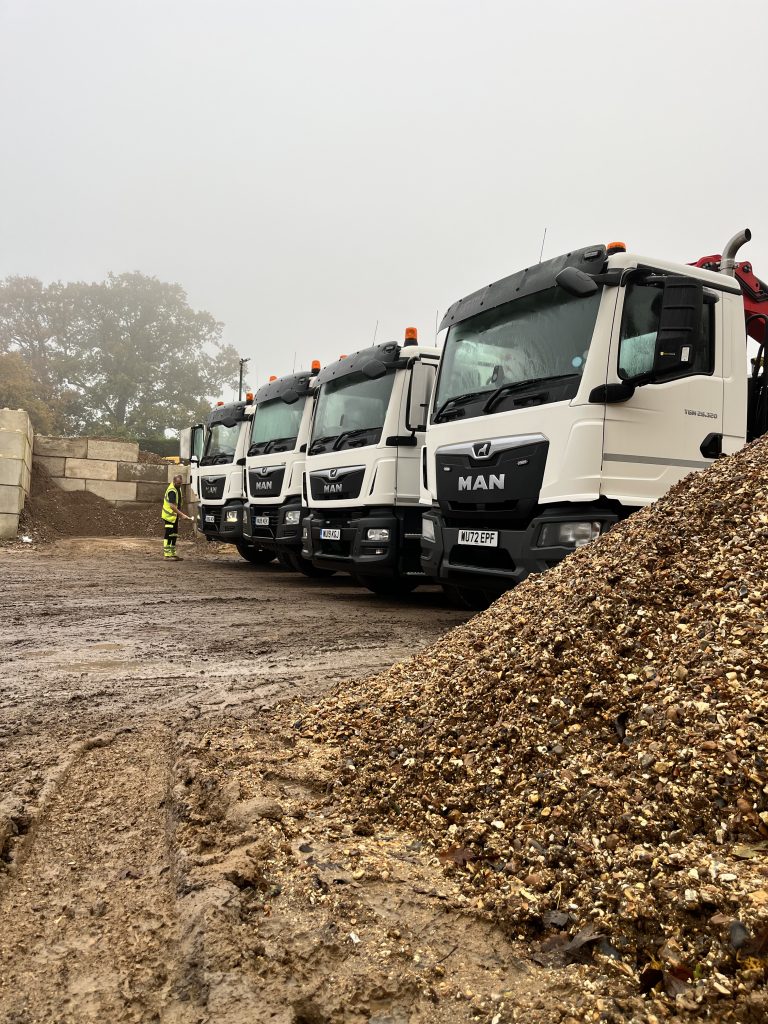
Before your delivery arrives, it helps to check a few practical points:
- There is enough access for a delivery lorry to reach the drop-off point.
- The tipping area is clear, ideally on a hard surface close to where the soil will be used.
- Driveways or lawns are protected with boards or a tarpaulin if the soil is being tipped on them.
- You have a wheelbarrow and enough help on hand to move the soil once it arrives.
If the area needs clearing before the new topsoil goes down, our grab lorries can remove old soil, turf and hardcore, and inert waste such as soil and rubble can also be taken to our waste transfer station in Fair Oak.
Topsoil from our Fair Oak yard
We supply topsoil for gardens and landscaping projects across Hampshire, including topsoil delivery in Southampton, Eastleigh, Portsmouth and Winchester. Customers close to the yard can also collect topsoil in Fair Oak, and calling ahead lets us have your order ready.
If you have measured your area but are unsure about the quantity, send us the length, width and the job you are planning, and the team can work out how much you need before you order. Call us on 023 8069 6482 or get in touch with our team to arrange delivery or collection.
Frequently Asked Questions
Multiply the length, width and depth of the area in metres to find the volume in cubic metres. Our aggregates calculator can do this for you, and the team can then confirm how much to order.
New turf is generally laid on around 100mm to 150mm of good-quality topsoil. This gives the roots room to establish and helps the lawn cope with dry spells during its first summer.
To fill a raised bed, multiply its internal length, width and depth in metres. A 2.4m by 1.2m bed that is 300mm deep holds about 0.86 cubic metres before allowing for settling.
New topsoil can be spread over existing ground once weeds, large stones and debris have been removed. Loosening the surface of the old soil first helps the two layers bond, which helps drainage and lets roots grow down more easily.
Topsoil settles as air pockets close up after it has been firmed and watered. This is why beds can sit lower a few weeks after filling, and why ordering a little more than your calculated volume is sensible.